Product field guide · Menguhan Bulut — Product Owner, Product Manager, AI Product Lead
What does a product manager actually do?
From a blank canvas to software in production — and everything that happens in between.
Ask ten companies what a Product Manager does and you may get twelve different answers.
At one company, the Product Manager is a strategist. At another, they are practically a Product Owner. Somewhere else, they are the person everyone asks: “When will it be ready?” And, of course: “Can we just add this one tiny thing?”
Spoiler: it is rarely tiny.
But underneath all the titles, methodologies, Jira boards, meetings and colorful sticky notes, the job is surprisingly simple to describe:
“A Product Manager helps a team understand the right problem, decide what is worth building, turn that understanding into something deliverable, and learn whether it actually worked.”
The difficult part is everything between those words.
01It starts before there is a backlog
A product doesn't begin with Jira. It begins with uncertainty.
Someone has an idea. A customer has a problem. The business sees an opportunity. A competitor launches something interesting. Revenue is dropping somewhere. Support tickets keep mentioning the same problem. And somebody eventually says: “We should build something.”
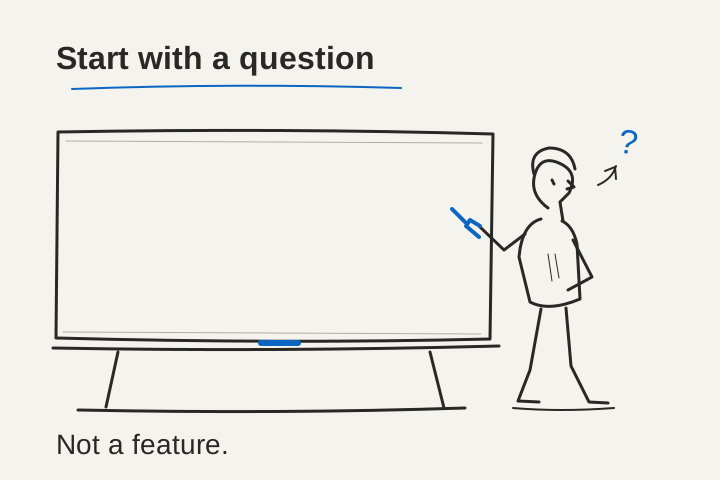
This is where Product Management should start asking questions rather than immediately creating tickets. Who actually has this problem? What exactly is the problem? How painful is it? How are people solving it today? Why should we solve it? Why now? And perhaps the most uncomfortable question: What happens if we build nothing?
Running Lean — problem validation
From my bookshelf: Running Lean by Ash Maurya — understand and validate the problem before becoming attached to the solution. View book
One of the most important ideas behind Running Lean is that you should understand and validate the problem before becoming emotionally attached to your solution. That's harder than it sounds. People love solutions. Solutions are exciting. Solutions have buttons. Problems are messy.
A Product Manager has to resist the temptation to jump directly into features. Before asking “What should we build?”, ask: “What problem are we actually solving?” That single question can save months of development.
02Put the assumptions on the table: Lean Canvas
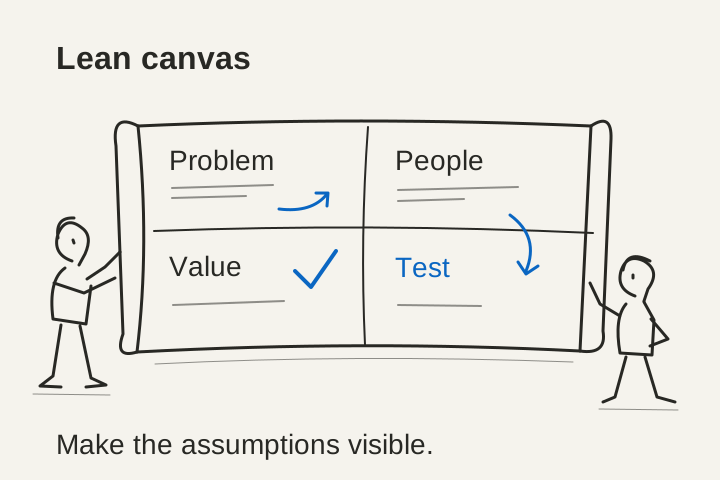
Every product idea contains assumptions. The dangerous ones are the assumptions that everybody has quietly started treating as facts. Customers want this. Do they? They'll pay for it. Will they? This feature will increase conversion. How do we know?
This is where something like a Lean Canvas becomes extremely useful. Instead of writing a fifty-page business plan that nobody will read again, you put the fundamental assumptions of the product on one page: Problem. Customer Segments. Unique Value Proposition. Solution. Channels. Revenue. Costs. Key Metrics. Unfair Advantage.
But the real value of the canvas isn't the canvas itself. It's the conversation it creates. Suddenly somebody asks: “Is that really our customer?” Someone else asks: “Do we know this, or are we assuming it?” And then the uncomfortable silence begins. Good. That's exactly what should happen.
“A good Product Manager doesn't hide uncertainty. A good Product Manager makes uncertainty visible.”
Once assumptions become visible, they can be tested.
03Inception: get everyone on the same bus
Now imagine this situation. Product thinks we're building A. Development thinks we're building B. Marketing has already announced C. And management expects all three by Friday. Welcome to software development.
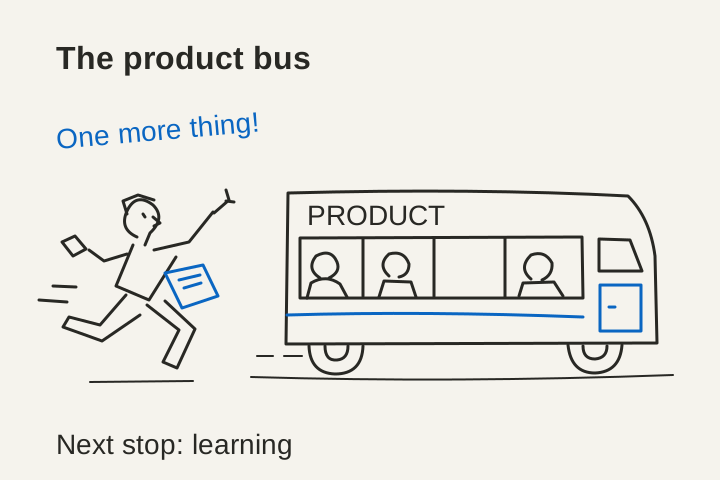
Before a team starts running, it helps enormously if everyone agrees about where they're actually going. That's the purpose of a good product inception. An inception should answer questions like: Why are we here? What are we trying to achieve? Who are we building this for? What does success look like? What's inside the scope? What's explicitly outside the scope? What are the biggest risks? What might the solution look like? How much effort might this require?
The Agile Samurai — inception tools
From my bookshelf: The Agile Samurai by Jonathan Rasmusson — elevator pitch, product box, NOT list, risks and rough sizing that prevent expensive late misunderstandings. View book
The Agile Samurai presents a wonderfully practical way of thinking about this with tools such as the elevator pitch, product box, NOT list, stakeholders, risks, solution visualization and rough sizing. None of these exercises exist because Product Managers desperately need more workshops. They exist because misunderstandings are expensive.
A two-hour disagreement in an inception meeting is cheap. Discovering the same disagreement after three months of development is not.
“Get everyone on the bus before you hit the accelerator.”
04Stakeholder management is not meeting management
Product Managers live at an intersection. Customers want something. The business wants something. Development sees technical reality. Design sees usability problems. Data sees patterns. Marketing sees positioning. Leadership sees strategy. Everyone is looking at the same product from a different angle.
The Product Manager's job isn't simply to forward messages between these groups. You're not a human Slack integration. The job is to create shared understanding.
User Stories Applied — requirements as communication
From my bookshelf: User Stories Applied by Mike Cohn — software requirements are fundamentally a communication problem. View book
This is one of the ideas that makes User Stories Applied so valuable: software requirements are fundamentally a communication problem. If business dominates the conversation, you can end up promising things that are unrealistic. If technology dominates it, you can build technically elegant software that nobody particularly needs. Product sits in the middle.
So instead of saying “Development says no,” a better Product Manager says: “Here's the goal. Here's the constraint. Here are our options. Here are the trade-offs. And here's what I recommend.” That's stakeholder management. Not having more meetings. Creating clarity.
05The roadmap is a direction, not a prophecy
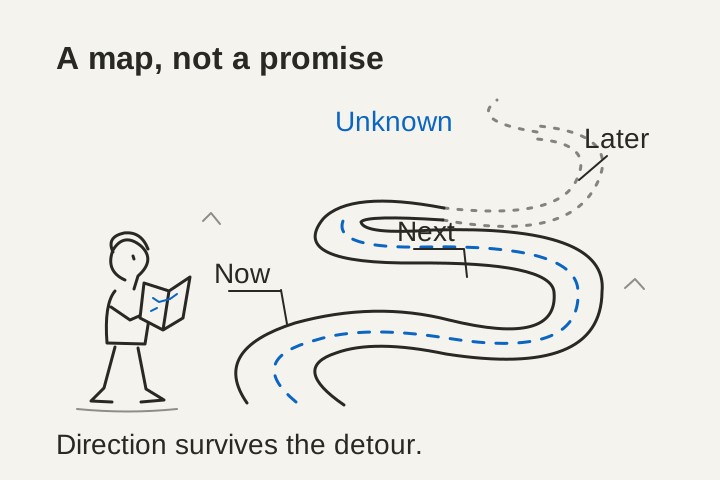
People love roadmaps. Especially roadmaps containing exact dates six months into the future. They look wonderfully reassuring. Unfortunately, software development has a habit of interacting with reality. Customers behave differently than expected. Technical problems appear. Priorities change. Experiments fail. Markets move. New information arrives.
A useful roadmap communicates: direction, priorities, outcomes and sequence. It should not pretend that the future is perfectly known. The further into the future you go, the less artificial precision you should have. Near-term work can be relatively concrete. Future work should increasingly represent intent rather than promises carved into stone.
Running Lean describes the journey from Plan A to a plan that works. That sentence contains an important product lesson. Your first plan is not sacred. It's a hypothesis. And The Agile Samurai gives us another useful idea: planning becomes more credible when you use the team's actual delivery rate to understand what is realistically possible.
So yes: have a roadmap. Just don't confuse it with a time machine.
06Now we can talk about cards
Eventually ideas have to become things a development team can actually build. Welcome to the world of: user stories, cards, tasks and acceptance criteria. But here's an important distinction: a Jira ticket is not a product requirement simply because it exists in Jira. And a 47-page specification pasted inside a Jira card is not automatically better.
A good story exists to support a conversation. Who needs something? What are they trying to accomplish? Why does it matter? How will we know it works? Then we add the details necessary to remove ambiguity: examples, business rules, edge cases and acceptance criteria.
User Stories Applied gives us a useful way to think about good stories. They should ideally be: Independent. Negotiable. Valuable. Estimatable. Small. Testable. Even the physical size of old-fashioned story cards had a benefit. There wasn't enough room to write a novel. That limitation forced people to keep the story concise and actually talk to each other.
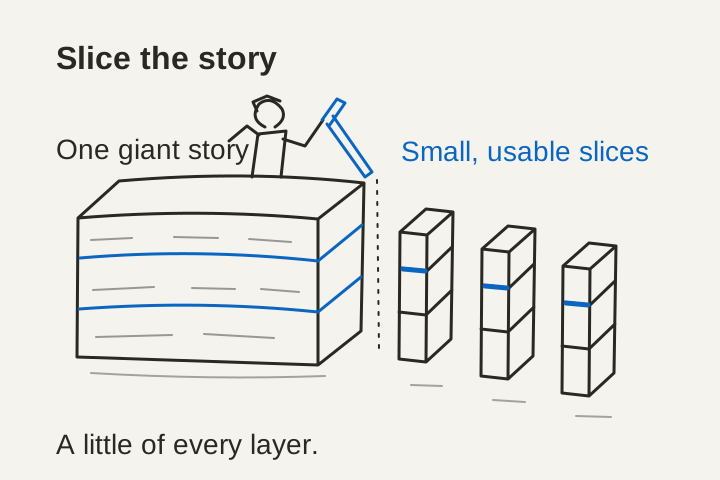
So how big should a card be? Small enough that the team can understand it. Small enough to estimate it reasonably. Small enough to finish and test it. But large enough to still represent something meaningful. If opening the Jira card requires twenty minutes of scrolling… we may have a hostage situation. The answer isn't always to create smaller tasks. The skill is learning how to slice value.
“Slice the work. Don't slice the value.”
07Lead the development team without trying to be their developer
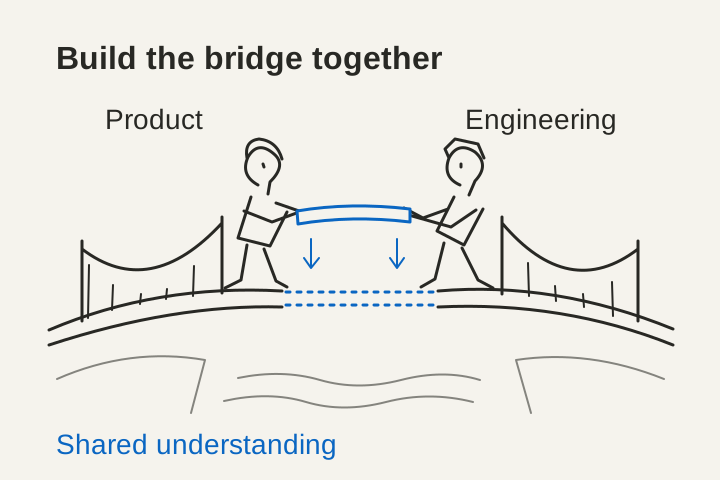
This relationship matters enormously. Product should own the what and why. Engineering should have strong ownership of the how. That doesn't mean throwing requirements over a wall and waiting for software to come back. The development team should understand the problem deeply enough to participate in solving it.
Tell them why the customer struggles. Show them the evidence. Explain the business constraint. Explain what success looks like. Then listen. Developers often see possibilities that Product doesn't. They may find a simpler solution. They may notice a technical constraint early. They may challenge an assumption. Good. That's not resistance. That's collaboration.
A Product Manager doesn't lead developers by pretending to be the smartest engineer in the room. You lead by providing: context, clarity, priorities and decisions. Then you solve the problem together.
08But understand the machine
There's another side to this. You don't need to be a software engineer to manage software products. But technical literacy is incredibly valuable. You should gradually understand things like: APIs. Databases. Clients and servers. Events. Caching. Dependencies. Authentication. Analytics. Releases. Architecture. Technical constraints.
You don't need to manufacture the engine. But if you're helping decide where the car should go, understanding what happens when you press the accelerator is useful.
But How Do It Know? — technical foundations
From my bookshelf: But How Do It Know? by J. Clark Scott — computers broken into understandable pieces, a useful mindset beyond computers. View book
That's why a book like But How Do It Know? belongs on a Product Manager's bookshelf. It takes something that appears mysterious — a computer — and breaks it into understandable pieces. That's a useful mindset beyond computers. Complexity becomes less intimidating when you understand the components and how they interact.
“Technical literacy improves conversations. And better conversations produce better decisions.”
09Iterations: build, learn, adjust, repeat
Eventually the product becomes real. Not in Figma. Not in Jira. Not in PowerPoint. In working software. Now the team enters a cycle: Build. Test. Demo. Release. Measure. Listen. Decide. And then do it again.
This is where Lean thinking becomes particularly powerful. Running Lean repeatedly brings us back to validation loops. Build something. Put it in front of reality. Measure what happens. Learn. Adjust. Repeat.
The Lean Startup — build, measure, learn
From my bookshelf: The Lean Startup by Eric Ries — iterate toward value, not merely toward output. View book
The goal isn't to become extremely efficient at producing features. A factory producing unwanted features faster is still producing unwanted features. The goal is to create value. Iterations give us opportunities to correct course before mistakes become enormous.
10Shipping is not the finish line
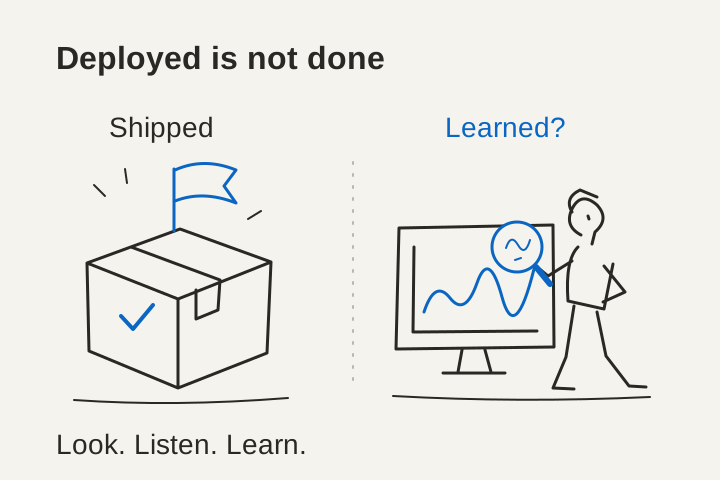
There's a beautiful moment in software development. The release goes live. Development celebrates that it's deployed. Product opens analytics.
Because releasing software answers only one question: can we build it? Now come the more interesting questions. Did people use it? Did they understand it? Did it solve the problem? Did conversion change? Did retention change? Did support tickets change? Did the metric we cared about actually move? Should we iterate? Scale it? Change it? Or perhaps remove it?
This is why measurement and feedback are part of Product Management, not something that happens after Product Management. Running Lean connects releasing with instrumentation, measurement, customer feedback and learning. Shipping isn't the end. Shipping is when your assumptions finally meet reality.
“Output is what we shipped. Outcome is what changed.”
For the operational side of this — store submission, staged rollout and post-release monitoring — see my mobile release management guide.
11Think in systems, not features
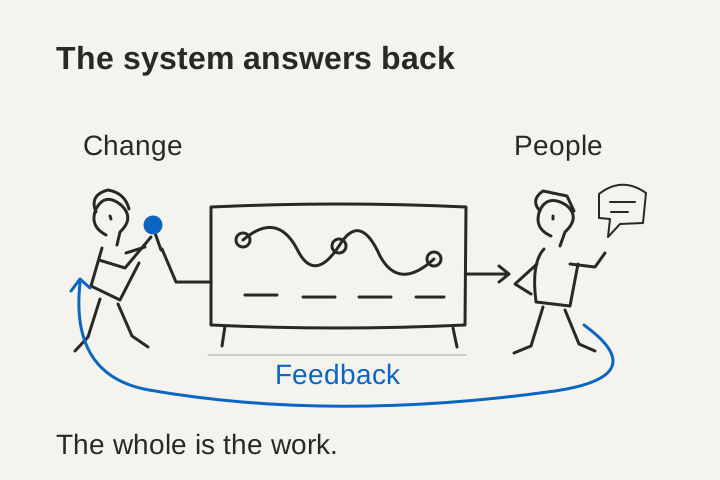
Products are systems. Change one thing and something else may move. Improve acquisition and activation becomes the bottleneck. Improve activation and infrastructure begins struggling. Increase conversion and customer support gets overwhelmed. Optimize one metric and accidentally damage another.
Thinking in Systems — structures and feedback
From my bookshelf: Thinking in Systems by Donella H. Meadows — look beyond events to structures, feedback loops and leverage points. View book
This is why Thinking in Systems is such a useful book for Product Managers. It encourages us to look beyond isolated events and examine structures, behavior, feedback loops, traps and leverage points. The mature product question isn't always “How do we build more?” Sometimes it's: “Where should we intervene to create the greatest useful change?”
A Product Manager who only sees features sees individual gears. A Product Manager who understands systems sees the machine.
“Don't optimize a gear while ignoring the machine.”
12And sometimes the problem is flow
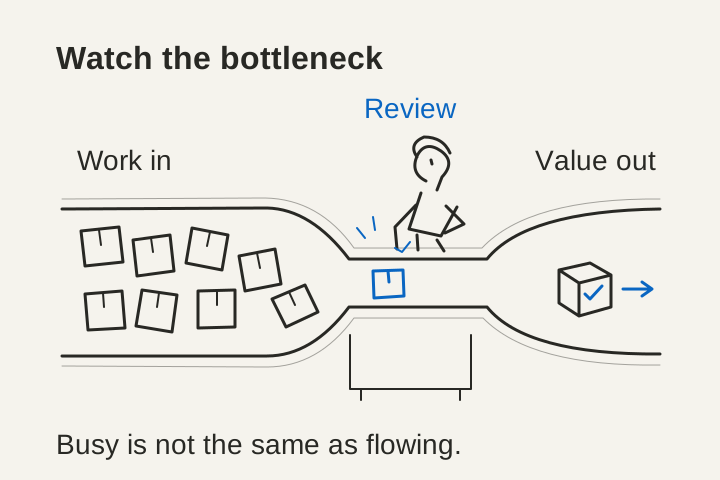
Here's another familiar situation. Everyone is busy. Development is busy. QA is busy. Product is busy. There are 27 tickets in progress. Slack is glowing. Meetings are happening. Jira looks magnificent. And somehow… nothing is getting finished.
This is where thinking about flow and constraints becomes important. Starting more work feels productive. Finishing valuable work is productive.
The Goal and The Phoenix Project — constraints and delivery
From my bookshelf: The Goal by Eliyahu M. Goldratt and Jeff Cox, and The Phoenix Project by Gene Kim, Kevin Behr and George Spafford — find the constraint and let valuable work flow. View The Goal · View The Phoenix Project
Books such as The Goal and The Phoenix Project are useful because they force us to think beyond individual productivity. Where is work waiting? Where are decisions waiting? Where are dependencies blocking progress? Where is the actual constraint? If ten people work faster but everything eventually queues behind one bottleneck, making those ten people even faster doesn't necessarily improve the system.
Product Management isn't only about deciding what enters the pipeline. It's also about understanding whether valuable work can actually flow through it.
“Starting more work is easy. Finishing valuable work is the game.”
13So, what is a product manager?
After all of that, my definition is still relatively simple:
“A Product Manager creates clarity where there is uncertainty and helps a team turn that clarity into measurable customer and business value.”
Sometimes that means strategy. Sometimes discovery. Sometimes saying no. Sometimes writing a user story. Sometimes sitting beside a developer trying to explain a bizarre edge case. Sometimes talking to marketing. Sometimes defending the development team from unnecessary interruption. Sometimes challenging the development team. Sometimes staring at analytics wondering why users are doing exactly the opposite of what everyone predicted. And occasionally… deleting something from the roadmap.
A Product Manager doesn't need to have every answer. But they should help the team keep asking the right questions.
LoopThe product manager's loop
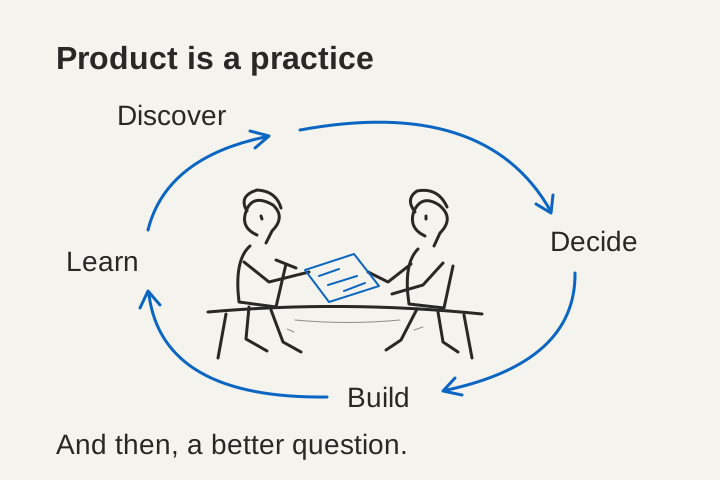
If I had to reduce the entire job to one loop, it would be this: understand the customer, problem and context. Align the people who need to solve it. Decide what matters now. Slice the problem into something meaningful and deliverable. Build with the team. Release into the real world. Measure what actually happened. Learn from reality. Repeat.
And then do it again. Product Management is not Jira administration. It's not meeting administration. It's not feature collection. And it definitely isn't pretending that you can perfectly predict the future. It's about understanding the problem. Bringing the right people together. Making decisions. Building the smallest meaningful thing. Putting it in front of reality. Learning. And going again.
And if somewhere along the way you encounter a 34-point user story… well… that's why every Product Manager should keep a small samurai sword nearby.
ShelfThe product manager's bookshelf
There are a handful of books behind many of the ideas in this article. They approach Product Management from different directions, which is exactly why I like putting them together. None of these books provides a magic recipe for Product Management. Together, however, they teach something much more useful: how to think about problems, people, software, uncertainty and systems. And that, more than any framework or tool, is what makes Product Management interesting.
Product and discovery
Turn assumptions into testable hypotheses and move from an idea toward something customers want.
View bookBuild, measure and learn in tight loops that test value instead of assuming it.
View bookAgile and delivery
Practical inception, planning and delivery habits that keep teams aligned.
View bookWrite small, valuable, testable stories that support conversation rather than replace it.
View bookEngineering discipline — feedback, courage and simplicity — that makes iteration safe.
View bookSystems and flow
See feedback, structure and leverage instead of isolated product events.
View bookFind the constraint that governs the whole system — then improve that first.
View bookHow delivery, operations and product work become flow instead of firefighting.
View bookTechnical thinking
Computers demystified into understandable pieces — useful far beyond computers.
View book